ait Dialogue #36: Ruth van Beek

ait Dialogue #36: Ruth van Beek

ait Dialogue #36: Ruth van Beek

ait Dialogue #36: Ruth van Beek

ait Dialogue #36: Ruth van Beek

This week on ait Dialogue, we meet Ruth van Beek, a Dutch artist whose collages breathe new life into forgotten photographs and everyday objects. With humor, intuition, and a sense of quiet mystery, she creates a visual language all her own.

This week on ait Dialogue, we meet Ruth van Beek, a Dutch artist whose collages breathe new life into forgotten photographs and everyday objects. With humor, intuition, and a sense of quiet mystery, she creates a visual language all her own.

/ Ruth in dialogue with Eylül & Selin /

Ruth van Beek (born 1977) is an artist based in Koog aan de Zaan, the Netherlands. Her work, which draws on a vast archive of found images and transforms them through collage and manipulation, has been exhibited internationally at institutions such as Foam, Les Rencontres d’Arles, Fotomuseum Antwerp, Fraenkel Gallery, and The Ravestijn Gallery, which represents her in Amsterdam. Her artist books, including The Arrangement (2013), The Cast (2017), How To Do The Flowers (2018), Eldorado (2020), and The Oldest Thing (2023) have been widely acclaimed, with two shortlisted for the Aperture Photobook of the Year Award. In addition to her studio practice, van Beek has taught at the Gerrit Rietveld Academy in Amsterdam since 2014, and her work has appeared in The New Yorker, Vogue, Foam Magazine, The British Journal of Photography, and The New York Times.

Your shapes often feel like childlike cutouts or instinctive mosaics - simple, naïve, yet unexpectedly new. What draws you to this language of forms?

In my work, I explore photography and its relationship to the photographed object, and photography when it itself is an object. The philosophical idea that the things around us exert influence, and that the actions of things produce effects in human and other bodies, is an important starting point. I believe that a naive attitude, with a conscious, almost childlike, gaze of unknowing, can help to better understand the relationship between people and things. 

The construction itself plays a significant role in the work's meaning. It's a literal way of making something move, bringing it to life, and then fixing it in a new form. Simple techniques keep the work organized, and my actions always remain visible. By “dressing” photos, making them blush, or adding small protrusions, a seductive illusion is created.

Bowl (Figure 146), 2023
Collage with photo and gouache painted paper, hand-stained grey wooden frame 13,5 x 18 cm

Your compositions may appear spontaneous or random, but they feel very resolved. How do you know when a work is finished? What tells you to stop?

I have long periods in which I make no collage works at all, I just work in the archive, looking, searching, trying to formulate what is my question, read books, make notes, paint and draw. When I start making the collage figures all this information is inside me and this allows me to work quickly and intuitively. I do not want to know in advance what I am making. One work should lead to another. The figures emerge playfully under my hands on the table. As I work, I make decisions. I work on an image until it, as it were, speaks back to me. I search for a presence that surprises me as well.

Eggs or seeds, 2022

60 photos constructed with small cuts to a folded gouache painted paper, 50 x 321 cm

How is your relationship with the digital world? Do you use digital tools in your practice, or do you prefer to stay close to the tactile?

My work is tactile, but I love the transformation of a work into an image when I put it on the scanner and see it on my monitor. Now it is photography again and I can endlessly reproduce and combine. For some years I also collect photographs I find online. I have for instance a collection of images of small doll furniture and socks. I am interested in how people use photography to show an object as clearly as possible, for selling something or exposing. Like for instance a series of images of someone trying to sell a small dollhouse table on Ebay. The table is photographed from all sides, I save the one where the table is lying on its back. Now something new is happening, the object becomes fragile, exposed, like a little animal with its paws up in the air.
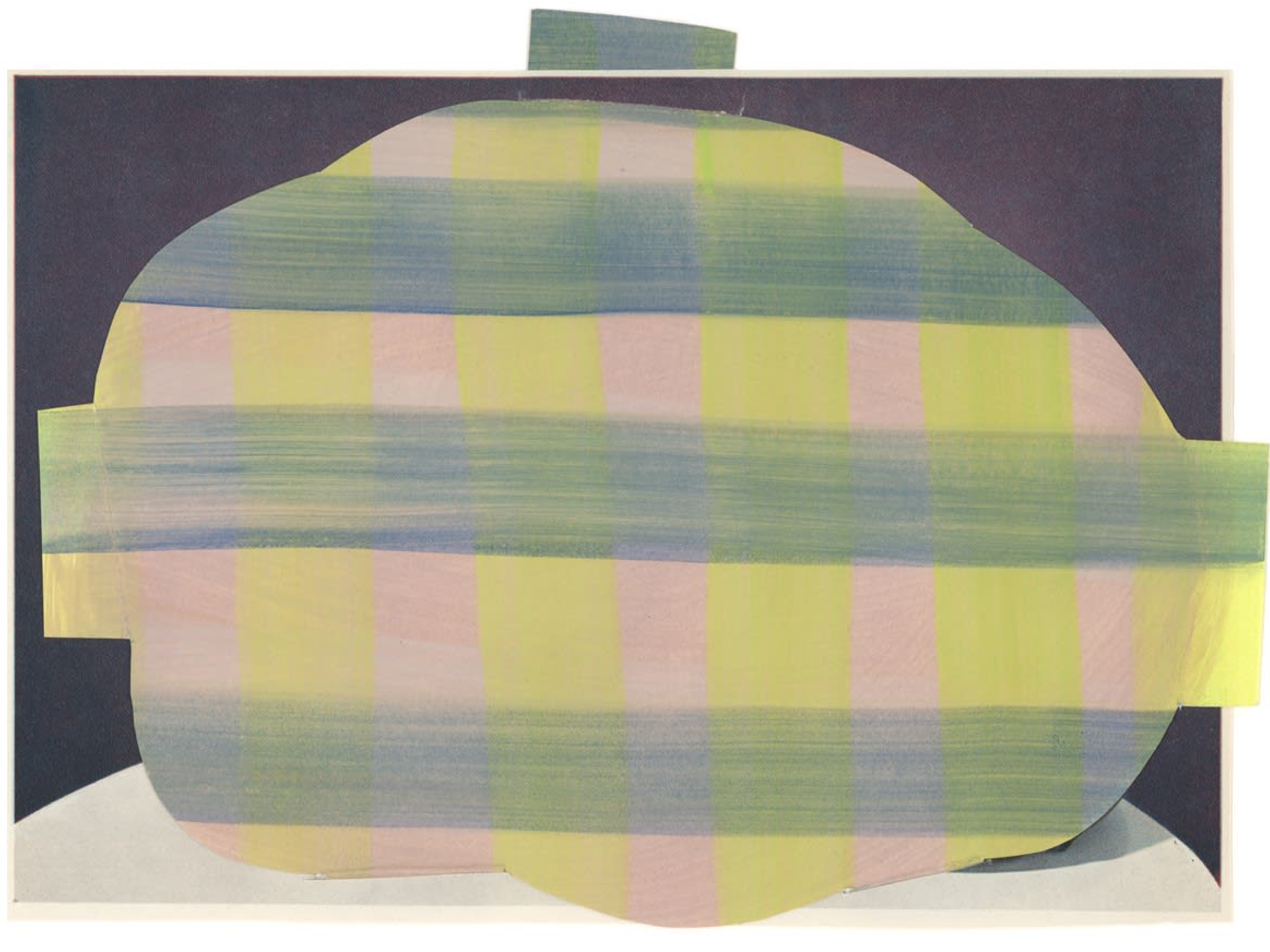
Doily (figure 137), 2022

Collage with photo and gouache painted paper, framed in hand stained wooden frame with museum glass. 15,5 x 21 cm

Books you’re making are very impressive. How does a book idea begin for you, and what does the process of shaping it look like?

Books and publications are an important part of my work. They are a platform where my works come to life, through which they travel and are seen. My books are emphatically objects of use. The vulnerability and uniqueness of the collages are counterbalanced by the book as a reproducible, tangible object. I see the books as spaces within which I can play with combinations, rhythm, and scale. The pages of a book offer a new freedom. Small collages can suddenly appear very large in a spread and thus take on a different position. I can also, as it were, allow the figures to engage in a conversation with each other by placing them side by side or combining them with archive images. Figures play different roles, and works from different moments in time come together. In this way, the books provide my collages with a new context. I think I always have the possibility of a book in the back of my head when making work.

What did you study and was there a moment (a turning point or crisis) that shaped your path in the art world?

I studied photography at the Gerrit Rietveld Academy and already during my studies I preferred to work with found images, or even treated my own photos like found material. Never had the patience for shooting film, preferred the physical form of photography, polaroid, found album photos, newspaper cut outs etc.

It took me a long time to find a podium for my work, books and self publishing helped a lot. I started making small publications myself and found an audience around the world. This gave me confidence to continue on this strange path. Also I became a mother quite young, when I was 25 and just graduated from art school, looking back I think this had a big influence on my work, although at the time I never thought about that.

The Oldest Thing

What are you most interested in these days?

Dolls, I am obsessed with dolls and images of dolls.
How do you define a “good artwork”? What qualities matter the most to you?

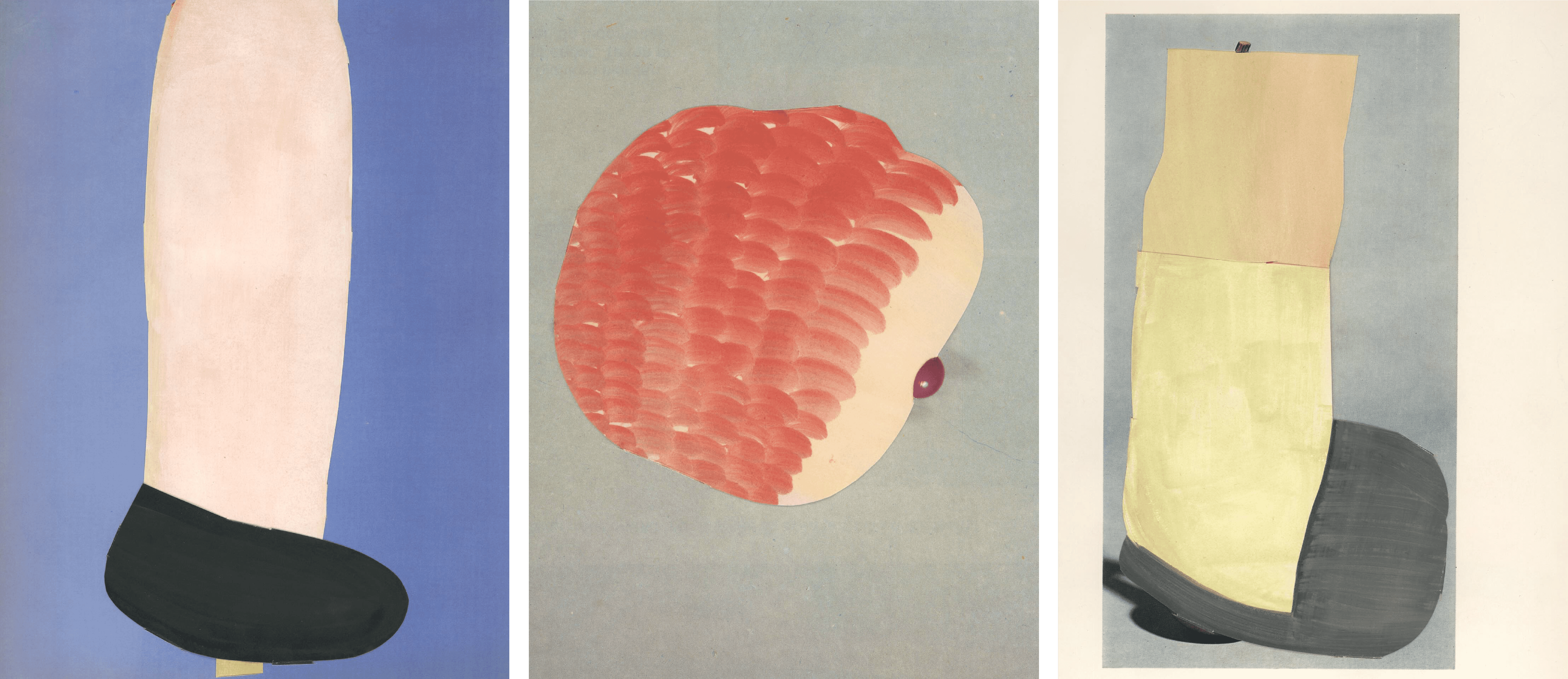
I like it that when you look at a work of art you can see the decisions of the maker. See their intentions, struggles, doubts or certainties. This I find very exciting, that some art has the ability to transport you to another time and place and be in the here and now at the same time.

Collage works for Hanatsubaki issue 833 “Wish

We recently saw your work at ARTER’s “I Need More Time” exhibition. Could you tell us a little bit about the process behind that piece?

In the summer of 2021, I worked on a new work at the invitation of Plaatsmaken in Arnhem. I learned screen printing and researched what I could do with it in my work. I learned to build color with layers of ink. For the work The Spell I made 100 screen prints, all identical in shape, an organic form that is often reflected in my work. A kind of egg shape, a fruit or a body. The color of each print is different. Again and again I used combinations of ink, looking for the right degree of transparency. Later in my studio I added small images from my archive to these serigraphs. They are images of common household activities, but also stranger things that form a distraction from the daily tasks. The work is intended as an incantation for a housewife, hence the title The Spell. Is it the woman who is under spell, or is it the woman who casts the spell to gain control?
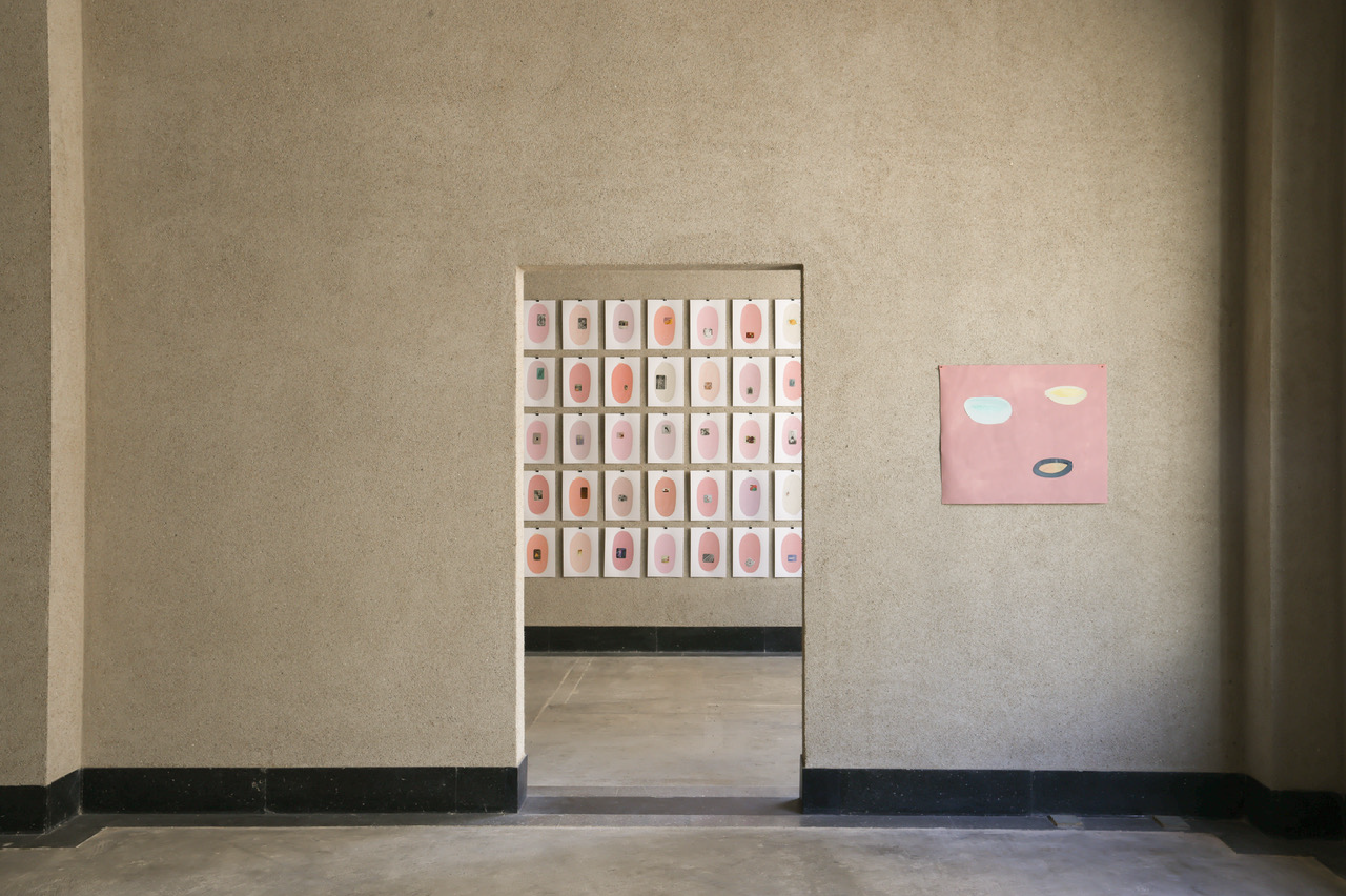
The Spell

To close: What gives you the urge to create? And what does “belonging” mean to you? Do you feel you belong where you live and in the life you’ve shaped?

Maybe it is out of curiosity? Or because it is a way to remember, to reconstruct, to visualize time? Do you mean belonging as in feeling at home? Yes I feel at home in the work I make. I think it is a bit like a machine that cannot stop. One thing leads to another, life gives ideas constantly. For 21 years I lived and worked in an 18th century house that belonged to a clockmaker. I like to think this has something to do with all of this…

Ruth’s List

Favorite museum, bookstore or local spot?

A small coffee place in Kyoto where I had the same breakfast every day. Pour over coffee, thick white bread toast with butter and a boiled egg.

The last book you read (or cut)?

The Book of Yokai, mysterious creatures of Japanese folklore, Michael Dylan Foster

All time favorite movie?

Twin Peaks

A material or tool you’ve been obsessed with lately?

My new brushes from Japan

A recent image from your camera roll that feels “very Ruth”?

A song that feels like one of your artworks?

“I Put a Spell on You” – Screamin’ Jay Hawkins

Ruth van Beek (born 1977) is an artist based in Koog aan de Zaan, the Netherlands. Her work, which draws on a vast archive of found images and transforms them through collage and manipulation, has been exhibited internationally at institutions such as Foam, Les Rencontres d’Arles, Fotomuseum Antwerp, Fraenkel Gallery, and The Ravestijn Gallery, which represents her in Amsterdam. Her artist books, including The Arrangement (2013), The Cast (2017), How To Do The Flowers (2018), Eldorado (2020), and The Oldest Thing (2023) have been widely acclaimed, with two shortlisted for the Aperture Photobook of the Year Award. In addition to her studio practice, van Beek has taught at the Gerrit Rietveld Academy in Amsterdam since 2014, and her work has appeared in The New Yorker, Vogue, Foam Magazine, The British Journal of Photography, and The New York Times.

Your shapes often feel like childlike cutouts or instinctive mosaics - simple, naïve, yet unexpectedly new. What draws you to this language of forms?

In my work, I explore photography and its relationship to the photographed object, and photography when it itself is an object. The philosophical idea that the things around us exert influence, and that the actions of things produce effects in human and other bodies, is an important starting point. I believe that a naive attitude, with a conscious, almost childlike, gaze of unknowing, can help to better understand the relationship between people and things. 

The construction itself plays a significant role in the work's meaning. It's a literal way of making something move, bringing it to life, and then fixing it in a new form. Simple techniques keep the work organized, and my actions always remain visible. By “dressing” photos, making them blush, or adding small protrusions, a seductive illusion is created.

Bowl (Figure 146), 2023
Collage with photo and gouache painted paper, hand-stained grey wooden frame 13,5 x 18 cm

Your compositions may appear spontaneous or random, but they feel very resolved. How do you know when a work is finished? What tells you to stop?

I have long periods in which I make no collage works at all, I just work in the archive, looking, searching, trying to formulate what is my question, read books, make notes, paint and draw. When I start making the collage figures all this information is inside me and this allows me to work quickly and intuitively. I do not want to know in advance what I am making. One work should lead to another. The figures emerge playfully under my hands on the table. As I work, I make decisions. I work on an image until it, as it were, speaks back to me. I search for a presence that surprises me as well.

Eggs or seeds, 2022

60 photos constructed with small cuts to a folded gouache painted paper, 50 x 321 cm

How is your relationship with the digital world? Do you use digital tools in your practice, or do you prefer to stay close to the tactile?

My work is tactile, but I love the transformation of a work into an image when I put it on the scanner and see it on my monitor. Now it is photography again and I can endlessly reproduce and combine. For some years I also collect photographs I find online. I have for instance a collection of images of small doll furniture and socks. I am interested in how people use photography to show an object as clearly as possible, for selling something or exposing. Like for instance a series of images of someone trying to sell a small dollhouse table on Ebay. The table is photographed from all sides, I save the one where the table is lying on its back. Now something new is happening, the object becomes fragile, exposed, like a little animal with its paws up in the air.

Doily (figure 137), 2022

Collage with photo and gouache painted paper, framed in hand stained wooden frame with museum glass. 15,5 x 21 cm

Books you’re making are very impressive. How does a book idea begin for you, and what does the process of shaping it look like?

Books and publications are an important part of my work. They are a platform where my works come to life, through which they travel and are seen. My books are emphatically objects of use. The vulnerability and uniqueness of the collages are counterbalanced by the book as a reproducible, tangible object. I see the books as spaces within which I can play with combinations, rhythm, and scale. The pages of a book offer a new freedom. Small collages can suddenly appear very large in a spread and thus take on a different position. I can also, as it were, allow the figures to engage in a conversation with each other by placing them side by side or combining them with archive images. Figures play different roles, and works from different moments in time come together. In this way, the books provide my collages with a new context. I think I always have the possibility of a book in the back of my head when making work.

What did you study and was there a moment (a turning point or crisis) that shaped your path in the art world?

I studied photography at the Gerrit Rietveld Academy and already during my studies I preferred to work with found images, or even treated my own photos like found material. Never had the patience for shooting film, preferred the physical form of photography, polaroid, found album photos, newspaper cut outs etc.

It took me a long time to find a podium for my work, books and self publishing helped a lot. I started making small publications myself and found an audience around the world. This gave me confidence to continue on this strange path. Also I became a mother quite young, when I was 25 and just graduated from art school, looking back I think this had a big influence on my work, although at the time I never thought about that.

The Oldest Thing

What are you most interested in these days?

Dolls, I am obsessed with dolls and images of dolls.

How do you define a “good artwork”? What qualities matter the most to you?

I like it that when you look at a work of art you can see the decisions of the maker. See their intentions, struggles, doubts or certainties. This I find very exciting, that some art has the ability to transport you to another time and place and be in the here and now at the same time.

Collage works for Hanatsubaki issue 833 “Wish

We recently saw your work at ARTER’s “I Need More Time” exhibition. Could you tell us a little bit about the process behind that piece?

In the summer of 2021, I worked on a new work at the invitation of Plaatsmaken in Arnhem. I learned screen printing and researched what I could do with it in my work. I learned to build color with layers of ink. For the work The Spell I made 100 screen prints, all identical in shape, an organic form that is often reflected in my work. A kind of egg shape, a fruit or a body. The color of each print is different. Again and again I used combinations of ink, looking for the right degree of transparency. Later in my studio I added small images from my archive to these serigraphs. They are images of common household activities, but also stranger things that form a distraction from the daily tasks. The work is intended as an incantation for a housewife, hence the title The Spell. Is it the woman who is under spell, or is it the woman who casts the spell to gain control?

The Spell

To close: What gives you the urge to create? And what does “belonging” mean to you? Do you feel you belong where you live and in the life you’ve shaped?

Maybe it is out of curiosity? Or because it is a way to remember, to reconstruct, to visualize time? Do you mean belonging as in feeling at home? Yes I feel at home in the work I make. I think it is a bit like a machine that cannot stop. One thing leads to another, life gives ideas constantly. For 21 years I lived and worked in an 18th century house that belonged to a clockmaker. I like to think this has something to do with all of this…

Ruth’s List

Favorite museum, bookstore or local spot?

A small coffee place in Kyoto where I had the same breakfast every day. Pour over coffee, thick white bread toast with butter and a boiled egg.

The last book you read (or cut)?

The Book of Yokai, mysterious creatures of Japanese folklore, Michael Dylan Foster

All time favorite movie?

Twin Peaks

A material or tool you’ve been obsessed with lately?

My new brushes from Japan

A recent image from your camera roll that feels “very Ruth”?

A song that feels like one of your artworks?

“I Put a Spell on You” – Screamin’ Jay Hawkins

VIEW ALL DIALOGUE
©Ait 2026

Istanbul , Turkey

Newsletter

Subscribe for monthly dose of creativity.

Projects & briefs

hello@aitistanbul.com

Collaborations & Careers

hiring@aitistanbul.com

©Ait 2026

Istanbul , Turkey

Newsletter

Subscribe for monthly dose of creativity.

Projects & briefs

hello@aitistanbul.com

Collaborations & Careers

hiring@aitistanbul.com

©Ait 2026

Istanbul , Turkey

Newsletter

Subscribe for monthly dose of creativity.

Projects & briefs

hello@aitistanbul.com

Collaborations & Careers

hiring@aitistanbul.com

Newsletter

Subscribe for monthly dose of creativity.

Projects & briefs

hello@aitistanbul.com

Collaborations & Careers

hiring@aitistanbul.com

©Ait 2026

Istanbul , Turkey

©Ait 2026

Istanbul , Turkey

Newsletter

Subscribe for monthly dose of creativity.

Projects & briefs

hello@aitistanbul.com

Collaborations & Careers

hiring@aitistanbul.com