/ Johan in dialogue with Eylül & Selin /

Johan Deckmann is a Danish contemporary artist and trained psychotherapist based in Copenhagen. Drawing on existential psychology, humor, and minimalist language, he creates artworks that explore fear, love, identity, overthinking, and the contradictions of modern life. Often taking the form of fictional self-help books or larger canvases, his work transforms familiar psychological experiences into objects that are at once funny, unsettling, and deeply recognizable. Rather than offering answers, Deckmann invites viewers to pause, reflect, and perhaps recognize a little more of themselves. His work has been exhibited internationally and is held in private collections around the world.
How is life in Copenhagen? Can you share a snap from where you are right now?
Life in Copenhagen is calm, safe, practical, beautiful, and slightly expensive, which is probably why people here look so thoughtful. Most of my days revolve around family, writing, making art, spending time with friends, and walking through the city.
I love Copenhagen's rhythm. Many of my ideas arrive while I'm walking, listening to music, buying groceries, or doing something completely ordinary. I've learned that ordinary moments are often where the best ideas hide.
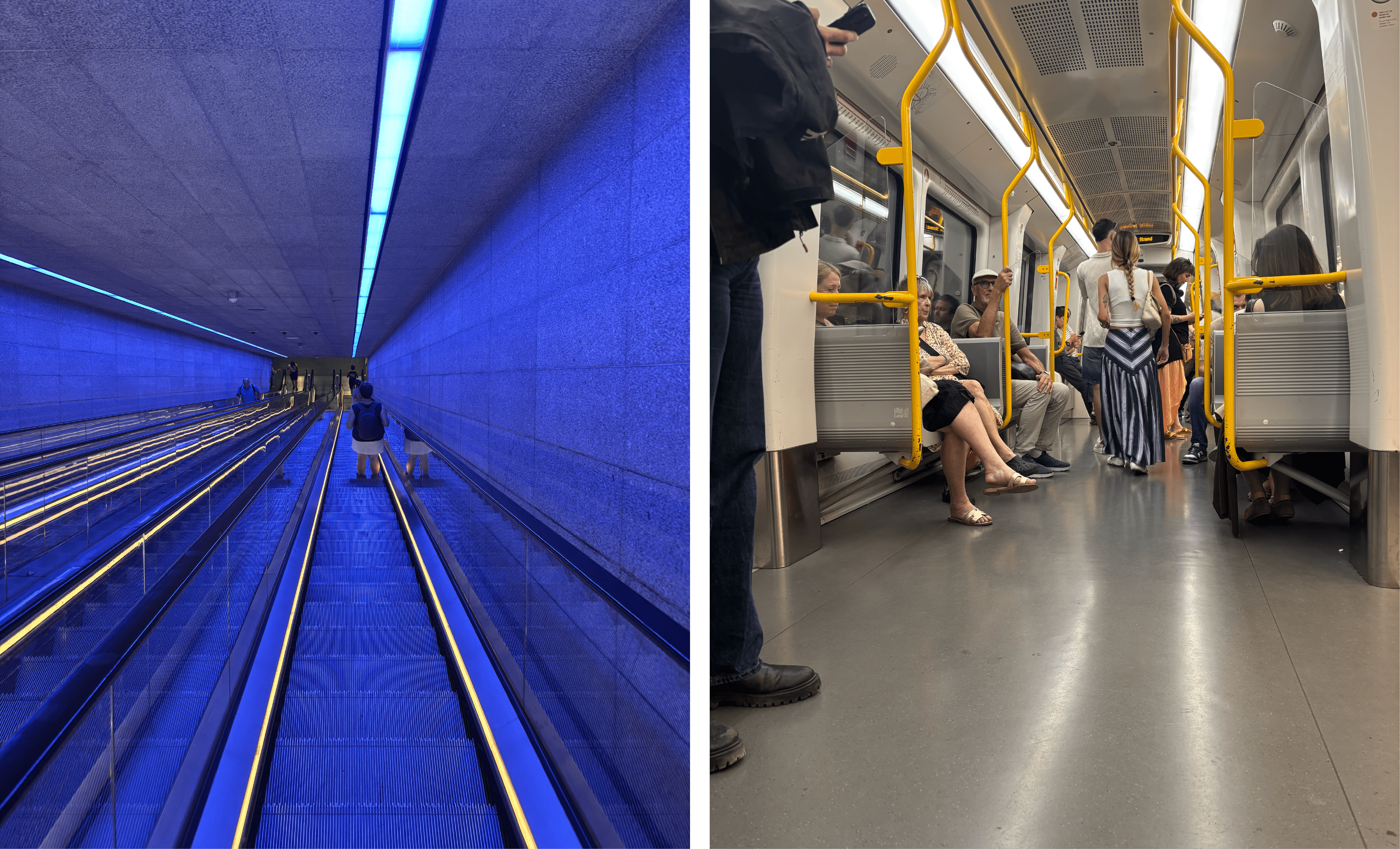
Life in CPH, through Johan’s lens.
Psychotherapist, artist, husband, and dad. If you had to write the "Table of Contents" for your life right now, which chapter would be the longest? How do you keep the balance between these titles?
Being a dad would definitely be the longest chapter. Being an artist takes up a lot of visible space, but family occupies the deepest space.
The nice thing is that all these roles feed each other. Being a psychotherapist taught me to listen and observe more carefully. Being an artist gives me somewhere to put those observations. And being a husband and father reminds me what actually matters the most.
What's the most "extraordinary" thing about you and the most "boring"?
The most extraordinary thing is probably that I've somehow managed to turn existential frustration into a profession. The most boring thing is that I genuinely enjoy quiet days with no plans and no expectations. The flowers grow if they want to.
You work with found objects. Tell me about the first spark. How did this all start?
It started very intuitively. I was drawn to old books because they already carry so much history and authority. A book looks trustworthy before it even says a word. It seems to promise knowledge, comfort, wisdom, or answers. Then I began placing very direct psychological titles on them, and suddenly the object changed completely. It became funny, sad, brutal, comforting, and absurd, all at the same time. That tension immediately felt right to me.
I still remember the moment the idea arrived. I was reading a beautiful old philosophy book when I suddenly imagined replacing its original title with one of my own. It wasn't really a strategy. It felt more like discovering a language I had been looking for without knowing it.

How does your working space look like?
My workspace is a mixture of studio, office, storage room, thinking space, and controlled chaos. There are books, canvases, works in progress, packaging, tools, notes, and probably several things I'm currently looking for but can't find. My favorite spot usually isn't the most beautiful one. It's simply wherever I happen to be writing. That's where the work really begins. And it doesn't always happen in the studio. Before the object, before the typography, before the finished artwork, there's usually just a single sentence trying to find its way into the world.
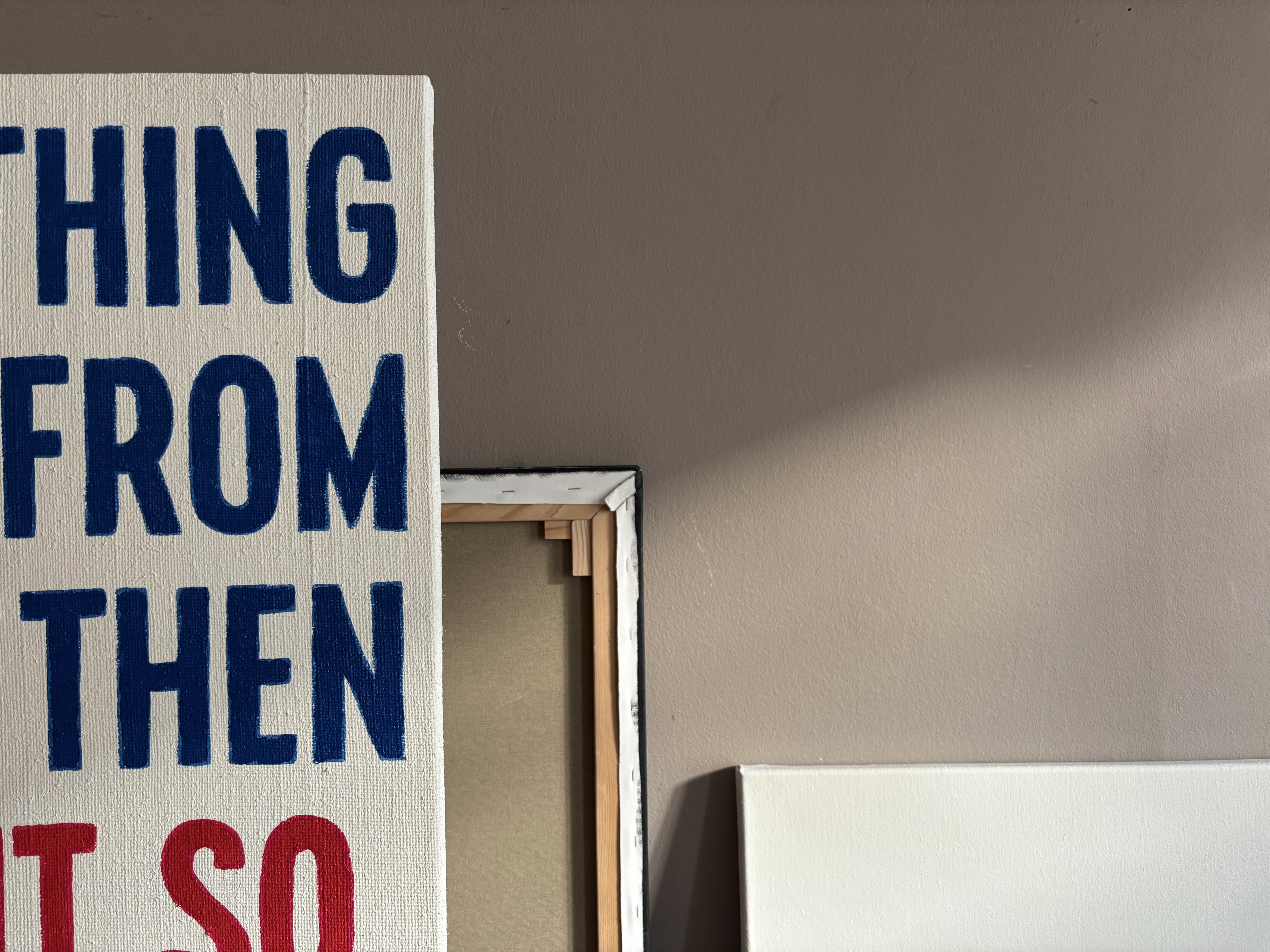
Your work is incredibly "Instagrammable"; it almost feels like high-art analog memes. How do you feel about your art being consumed in the same place people scroll for cat videos? What's your real relationship with "social"?
I actually enjoy that contradiction. My work can exist in a gallery, in a collector's home, or between a cat video and someone making pasta. That feels very contemporary to me. If a work reaches someone while they're lying in bed, half asleep, slightly anxious, and avoiding life for five minutes, that might actually be the perfect psychological setting.
The danger comes when everything becomes content. I still care deeply about the physical object, its weight, texture, scale, typography, color, and presence. The online image is an entrance, not the whole house.

Sarcasm and minimalism: Is it just an art form for you, or a lifestyle?
Although I have a family, I actually live quite a minimalist life. I keep life simple.
I value the present moment and being there for the people I love. That's at the very top of my list of priorities. Everything else – art, practical matters, money – comes afterwards. So even though my work isn't autobiographical, I think I live many of the same ideas that my work explores. I'm very conscious – and fairly uncompromising – about how I choose to live my life.
Sarcasm is different. I have a great deal of respect for it, and I use it carefully. Almost the way a martial artist uses their skills outside the dojo. Sarcasm often wraps truth or criticism inside humor, which works beautifully in art. But in everyday life it can hurt people deeply. That's why I mostly save it for my work—or for close friends who know exactly where it's coming from.
That said, I don't think my work is really about sarcasm. Sarcasm on its own becomes cold very quickly. I'm much more interested in the place where humor, sadness, truth, and tenderness meet.
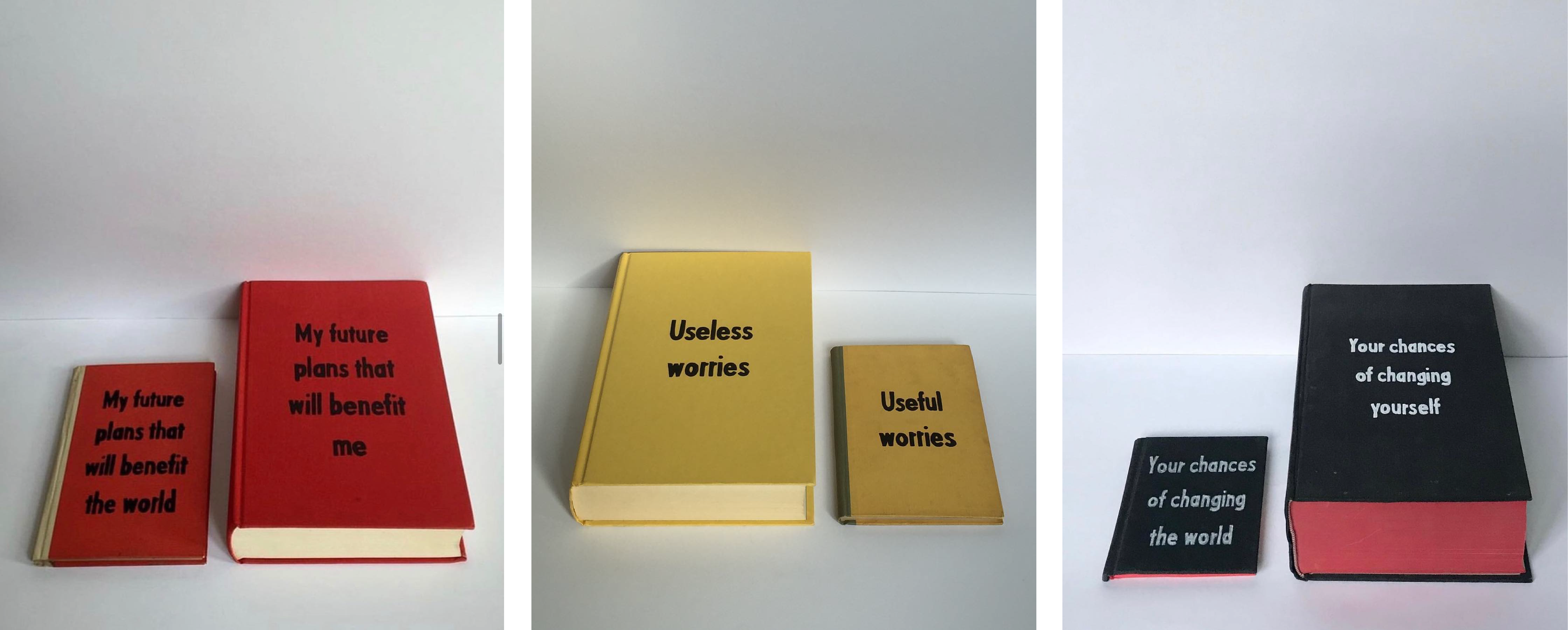
And to close: If you could prescribe just one of your book covers to the entire world right now to "cure" 2026, which one would it be?
I would probably prescribe How to Avoid Getting Caught Up in the Madness. Not because I think the world has suddenly become more chaotic, but because history has repeatedly shown us how easily human beings get swept up by fear, certainty, division, and collective thinking.
We're all familiar with the idea of evidence-based science – knowledge built on observation, experience, and repeated proof. In a way, I think we can apply the same principle to ourselves. History has already given us plenty of evidence of what we're capable of, both at our best and at our worst.
So perhaps what we need isn't just advice on how to survive physically, but also psychologically. I think that's one of the places where art may play a much bigger role than we often realize. Art can't solve our problems, but it can help us remain human while we're living through them.
Johan’s List
Last photo on your phone?
A cool graffiti tag on a broken wall.
Favorite emoji?
“🙂”
Because it looks friendly—but also just slightly emotionally suspicious. It's the emoji equivalent of the Mona Lisa.
Your favorite movie scene?
I've always loved the scene in The Godfather where, after Vito Corleone's death, everyone approaches Michael, kisses his hand, and addresses him as the new Don. Almost nothing is said, yet everything changes. What fascinates me isn't the power itself, but the psychology behind it. Michael doesn't become someone else in that moment—the people around him simply begin to see him differently.
Wish come true lately?
Traveling with my family.
Best moment of the day?
Picking up my youngest son from school.
Most useless talent?
I can make a matchstick jump just by balancing it on my finger. I learned the trick from an old man who worked at my fathers antique shop when I was a young boy. But maybe it hasn't been completely useless after all – my children still find it surprisingly entertaining.
A song that feels like your artwork?
That's a difficult one. Probably something that's beautiful and melancholic at the same time. A song that somehow smiles while quietly falling apart. Maybe a song from the wonderful Sufjan Stevens.
The last book you actually read?
The Creative Process in Gestalt Therapy by Joseph Zinker.
VIEW ALL DIALOGUE